Most people think persuasion is about talking louder. They’re wrong. Dead wrong.
You walk into a room full of strangers. Within minutes, some people command attention while others fade into background noise. The difference isn’t charisma or luck—it’s mastery of an ancient art most people butcher daily.
Aristotle mapped the blueprint 2,300 years ago. Three simple weapons that separate leaders from followers, winners from losers, the influential from the invisible. Yet watch any meeting, any argument, any attempt at influence today, and you’ll see people fumbling around like blind soldiers on a battlefield.
They spray facts without context. They appeal to emotions without credibility. They position themselves as experts while radiating incompetence from every pore.
Here’s the brutal truth: If you can’t persuade, you can’t lead. If you can’t lead, you’re destined to follow someone who can. And following means accepting whatever scraps of success others decide you deserve.
The Fatal Flaw That Kills Most Persuasion Before It Starts
Watch someone fail at persuasion and you’ll see the same pattern every time. They focus on what they want to say instead of what needs to be heard. They build arguments for themselves instead of for their audience.
This is why smart people often persuade poorly. Intelligence becomes a curse when it convinces you that logical arguments alone move mountains. Meanwhile, people with average IQs but superior understanding of human psychology run circles around them.
“The fool thinks himself to be wise, but the wise man knows himself to be a fool,” Shakespeare observed centuries ago. This wisdom applies perfectly to persuasion. The moment you think you understand people, you’ve already lost them.
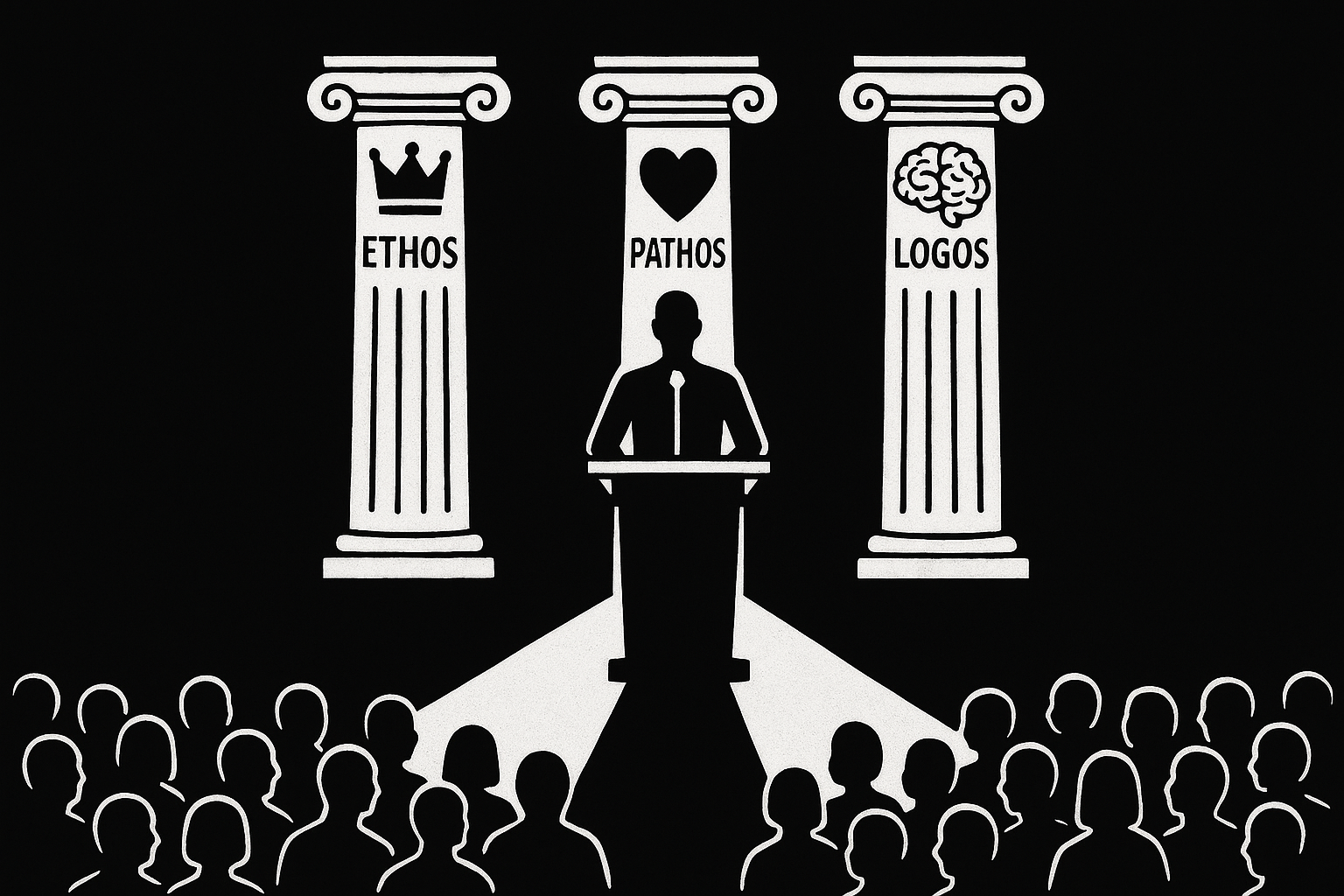
Aristotle understood this. His three pillars of persuasion—Ethos, Pathos, and Logos—aren’t separate techniques to choose from. They’re interconnected weapons that must work together, or they fail individually.
Ethos: Why People Follow Authority (Even When Authority Is Wrong)
Your first battle isn’t with logic or emotion. It’s with credibility. People don’t listen to what you say until they trust who you are.
Ethos operates on three levels that most people completely misunderstand:
Reputation precedes everything. Your past follows you into every conversation. The homeless man on the corner might have brilliant insights about economics, but his appearance kills his credibility before he opens his mouth. Fair? No. Reality? Absolutely.
Smart persuaders understand this ruthless truth. They build their reputation systematically, knowing that influence tomorrow depends on actions today. They choose their battles carefully because every interaction either builds or destroys their credibility bank account.
Character trumps competence. People would rather follow someone they trust over someone they fear. This is why authentic flaws often persuade better than perfect facades. When you admit small weaknesses, people trust you with big decisions.
The key word is “small.” Admit you’re terrible with technology, and people will trust your business judgment. Admit you’re dishonest about money, and they won’t trust you to hold their coffee.
Expertise must be demonstrated, not declared. Saying “I’m an expert” is like saying “I’m funny.” If you have to announce it, it’s probably not true.
Real experts show their knowledge through questions, not answers. They reveal depth through curiosity, not certainty. They demonstrate mastery by making complex ideas simple, not by making simple ideas complex.
Pathos: The Emotional Backdoor That Bypasses Logic
Logic convinces minds. Emotion moves mountains. And most people trying to persuade ignore the mountain entirely.
Here’s what separates master persuaders from amateurs: They understand that people make emotional decisions and then use logic to justify those decisions. Not the other way around.
Values are the ultimate emotional trigger. Tell someone their approach is inefficient, and they might listen. Tell them their approach violates their core values, and they’ll fight to change it.
This is why the most persuasive arguments don’t attack positions—they align with underlying values. Instead of saying “Your plan won’t work,” say “Your plan doesn’t honor the principles that make you who you are.”
Stories bypass rational defenses. When you present facts, people evaluate them. When you tell stories, people experience them. The human brain is wired to learn through narrative, not data.
Smart persuaders don’t say “Studies show X leads to Y.” They say “I watched Sarah struggle with this exact problem until she discovered…”
Contrast creates urgency. People don’t move toward good options. They move away from bad outcomes. The most persuasive presentations spend more time on consequences of inaction than benefits of action.
As the ancient Chinese philosopher Lao Tzu warned: “He who knows that enough is enough will always have enough.” But in persuasion, “enough” motivation rarely moves anyone. You need urgency that makes standing still feel more dangerous than moving forward.
Logos: Why Logic Alone Never Wins (But Why You Still Need It)
Logic is the scaffolding, not the building. It supports persuasion but doesn’t create it. Yet most educated people try to persuade with logic alone, then wonder why their brilliant arguments fall flat.
Evidence must be undeniable and relevant. Having proof isn’t enough. You need proof that matters to your specific audience in your specific situation.
A software engineer arguing for budget allocation shouldn’t cite abstract productivity studies. They should show specific examples of how similar investments solved similar problems for similar companies.
Reason connects dots, but only after emotion creates desire. Once people want to believe you, logic gives them permission. Before they want to believe you, logic gives them ammunition to resist.
This is why the sequence matters: Establish credibility first (Ethos), create emotional investment second (Pathos), then provide logical justification third (Logos).
Syllogistic thinking structures your arguments. Major premise: All successful companies invest in employee development. Minor premise: We want to be a successful company. Conclusion: We should invest in employee development.
This isn’t just academic exercise. It’s how persuasive minds naturally organize their thinking. When you structure arguments this way, people follow your logic intuitively, even when they can’t articulate why.
The Integration Challenge: Why Most People Fail at All Three
Here’s where most persuasion attempts die: People try to use these weapons separately instead of together. They establish credibility OR appeal to emotion OR present logic. The magic happens when you integrate all three simultaneously.
Watch a master persuader in action and you’ll see seamless transitions:
“In my fifteen years solving problems like this (Ethos), I’ve seen too many teams sacrifice their values for quick wins (Pathos). The data shows these shortcuts always cost more than they save (Logos).”
Three weapons, one sentence, devastating effectiveness.
The integration requires understanding your audience’s specific combination of credibility needs, emotional triggers, and logical frameworks. Cookie-cutter approaches fail because every situation demands a unique blend.
The Dark Side: When Persuasion Becomes Manipulation
With power comes responsibility. These weapons can build or destroy, elevate or manipulate, serve or exploit.
The line between persuasion and manipulation isn’t in the techniques—it’s in the intent. Persuasion seeks mutual benefit. Manipulation seeks one-sided advantage.
Ethical persuaders use these tools to help people make better decisions for themselves. Manipulators use them to trick people into making bad decisions for others’ benefit.
As the German philosopher Friedrich Nietzsche observed: “He who would learn to fly one day must first learn to stand and walk and run and climb and dance; one cannot fly into flying.” Master the fundamentals ethically before attempting advanced techniques.
Beyond Aristotle: Modern Applications of Ancient Wisdom
These principles didn’t become obsolete with the internet. They became more important. In a world drowning in information, credibility, emotional connection, and clear logic are rarer and more valuable than ever.
Digital communication strips away many traditional credibility signals. Your reputation online might matter more than your reputation in person. Your ability to create emotional connection through text might determine your influence more than your ability to command a room.
The fundamentals remain constant. The applications evolve daily.
The Choice You Can’t Avoid
You’re already trying to persuade people every day. The question isn’t whether to learn these skills—it’s whether to learn them well or poorly.
Every email you send attempts persuasion. Every meeting you attend involves influence. Every relationship you build requires all three of Aristotle’s weapons.
You can continue fumbling through these interactions, hoping sincerity and good intentions will carry you. Or you can master the tools that have separated leaders from followers for over two millennia.
The choice reveals who you really are and who you’re willing to become.
For those ready to master these weapons and many others, dive deeper into the art of mental dominance at The Mind Tools. And if you’re serious about building a mind sharp enough to cut through any resistance, explore The Mind Tools Books for advanced strategies most people will never discover.
Stop hoping people will listen. Make them want to.


Leave a Reply